Lybrafinance esLBR vesting released LBR gradually and reduced early-exit payouts in the 2023 V2 design
Lybrafinance esLBR vesting in the 2023 V2 design converted unlocked, nontransferable esLBR through a 90-day LBR release schedule. An active boost lock delayed the start. Starting vesting reduced the selected esLBR balance, while early exit reduced the LBR payout. Restaking returned the outstanding entitlement to esLBR.
In short: In the 2023 V2 design, restaking returned outstanding vesting as esLBR, while premature unlocking reduced the holder's LBR entitlement.
Unlocked esLBR could enter vesting or remain escrowed
The boost unlock time determined whether an esLBR holder could start vesting, while retaining the balance preserved its escrowed form. The June 2023 rewards-pool implementation checked that time before accepting a conversion. Reaching the unlock time permitted vesting without automatically starting a release schedule or transferring LBR into the wallet. esLBR connected token incentives with protocol revenue participation. The subsequent vesting period governed LBR release through its own clock. Time spent in the boost lock did not count toward the later release schedule.
Extending or restarting a boost lock moved its unlock time. The 2023 lock rules prevented shortening an active term, and re-locking restarted the selected period. Waiting for expiry left that commitment unchanged.
Vesting choices changed balances and future access
The June 2023 V2 design provided distinct choices for retaining esLBR, releasing LBR or returning an unfinished schedule to escrow. Each choice affected a particular balance. Starting a schedule reduced esLBR; ordinary withdrawals released only accrued LBR. Early exit and restaking cleared the schedule through different token outcomes.
| Choice in the June 2023 design | Balance affected | Access constraint or consequence |
|---|---|---|
| Retain esLBR | The escrowed balance remained | No LBR vesting schedule began automatically |
| Select a boost lock | esLBR remained escrowed | The unlock time restricted starting conversion |
| Start vesting | Selected esLBR became a scheduled LBR entitlement | The boost unlock check had to pass |
| Withdraw released LBR | Accrued LBR reached the beneficiary | Unelapsed vesting remained reserved |
| Add esLBR to ongoing vesting | New conversion joined the remaining entitlement | The outstanding schedule restarted |
| End vesting prematurely | The holder received a reduced LBR payout | Early exit required more than three days of the current cycle to elapse; the forfeited portion entered the bounty balance |
| Restake outstanding vesting | Reserved and unwithdrawn claimable amounts returned as esLBR | The previous LBR schedule cleared |
Scheduled withdrawals followed elapsed time
Normal withdrawals released LBR accumulated since the preceding withdrawal, with accrual stopping at the schedule's end. The June 2023 rewards-pool implementation used a 90-day exit cycle. It divided the scheduled amount by that duration to determine the release rate per second.
Released and reserved LBR occupied different states
Claimable LBR represented elapsed vesting the account had not yet withdrawn; reserved LBR represented the unelapsed portion. Withdrawing claimable LBR left the remaining schedule running, while the wallet received the released tokens. The end timestamp capped accrual, so leaving a completed schedule untouched did not create additional scheduled LBR.
Those amounts described token entitlements, while ordinary withdrawal minted LBR for the beneficiary. It did not exchange those tokens for eUSD or peUSD or redeem stablecoins against collateral.
Another conversion recalculated the remaining schedule
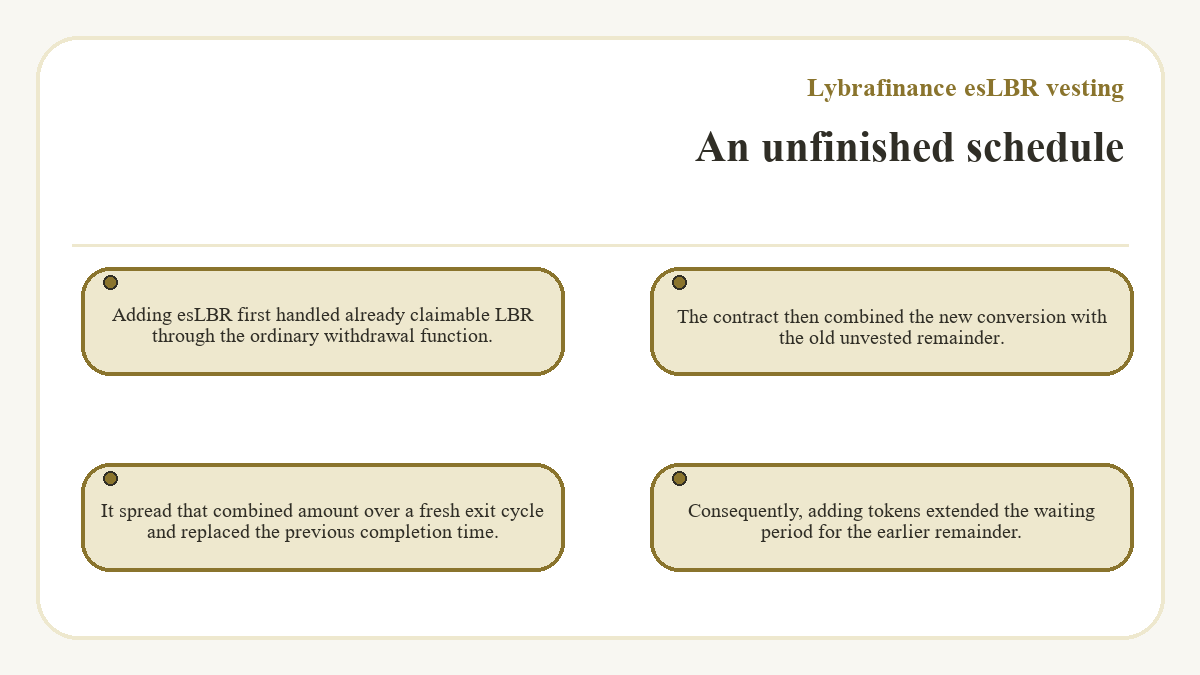
An unfinished schedule
Adding esLBR first handled already claimable LBR through the ordinary withdrawal function. The contract then combined the new conversion with the old unvested remainder. It spread that combined amount over a fresh exit cycle and replaced the previous completion time. Consequently, adding tokens extended the waiting period for the earlier remainder.
An elapsed schedule
When the earlier completion time had passed, another conversion first handled any unwithdrawn LBR from that completed schedule. The new conversion then supplied the next scheduled amount. Previously withdrawn LBR stayed outside this calculation; the contract did not place it back into vesting.
Why did ending vesting early reduce the LBR payout?
Premature unlocking paid already claimable LBR plus a reduced portion of the remaining reserve, forfeiting the rest of that reserve. The June 2023 implementation calculated the advance-release portion separately. It then added the claimable amount to determine the holder's immediate LBR payout.
The reduction applied to unvested entitlement. LBR already withdrawn stayed in the wallet, while the remaining-time calculation affected the reserved portion. A headline penalty percentage therefore needed a clear basis: the starting conversion, outstanding reserve and immediate payout represented different quantities.
In the June implementation, the advance-release fraction of the remaining reserve equaled (75 - 70 × remaining days / 87) / 100. Remaining days included fractional days, and integer token arithmetic introduced rounding. The contract then added already claimable LBR, so the total payout differed from applying this fraction to the original conversion amount.
Completing premature unlocking cleared the release rate and completion time. The contract moved the forfeited portion into a pool-wide bounty balance. No continuing schedule remained for that forfeited entitlement.
Restaking returned outstanding vesting to esLBR
Restaking recovered the outstanding entitlement in escrowed form and stopped the associated LBR release schedule. The June 2023 implementation returned reserved and unwithdrawn claimable amounts as esLBR when the holder restaked. The function cleared the schedule's release rate and completion time.
The scope was the account's outstanding vesting balance. Restaking did not take back LBR already withdrawn, and it did not restore amounts forfeited through an earlier premature exit. Holding the returned esLBR also restored the balance used for future protocol revenue accounting.
A later conversion started a new vesting cycle. Restaking did not preserve credit for elapsed time in the cancelled schedule.
The remaining esLBR balance governed revenue participation
Protocol revenue participation followed the esLBR balance, while the vesting schedule accounted for future LBR release. Starting conversion burned the selected esLBR, reducing the balance used for subsequent revenue calculations. Before changing balances, the June 2023 token contract attempted to refresh accrued rewards. A caught refresh failure allowed minting or burning to continue and could distort earlier unrecorded rewards. Restaking minted esLBR again. Previously accrued protocol rewards used separate accounting and a different claim function from the LBR withdrawal function. A stablecoin revenue claim did not itself advance vesting or release reserved LBR.
Forfeited vesting supplied a separate bounty
Vesting forfeitures increased the pool-wide amount available for bounty purchase, and buyers received newly minted esLBR as the recorded balance decreased. The June 2023 vesting-bounty function burned the buyer's LBR payment. The exiting holder's forfeiture and the buyer's payment were different quantities.
The purchase ratio in that implementation was owner-adjustable. September 2023 V2 terms described a 40% discount for vesting bounties. That discount concerned purchasing escrowed tokens; it did not specify the exiting holder's payout. Acquiring bounty esLBR did not automatically start its vesting schedule or produce an immediate LBR withdrawal.
Vesting records distinguished pending entitlement from paid LBR
The completion time and withdrawal history distinguished LBR still scheduled for release from tokens already paid to the wallet. In the June implementation,
getClaimAbleLBR
returned the unwithdrawn released amount.
getReservedLBRForVesting
returned the unelapsed reserve. The scheduled amount and wallet balance therefore answered different questions. The
UnstakeLBR
event recorded the selected conversion amount, while
WithdrawLBR
recorded the withdrawal amount and beneficiary.
Restake
recorded the entitlement returned to esLBR. A past completion timestamp capped normal accrual. A cleared timestamp followed restaking or premature unlocking, whose balance changes identified the particular outcome.
A conversion rejected by the boost unlock check left the preceding token balances and vesting schedule unchanged. Waiting for that lock's expiry preserved the existing commitment. The time check restricted starting or enlarging vesting. Ordinary withdrawals and restaking remained separate functions without that time check in the June implementation.
Lybrafinance esLBR vesting: what people ask
Do I need an ERC-20 spending allowance to start esLBR vesting?
The June 2023 conversion function burned esLBR directly through the authorized rewards pool without requesting a spending allowance. It checked the caller's boost unlock time before burning the selected amount.
When did the June 2023 contract permit premature unlocking?
Premature unlocking required more than three days to have elapsed since the current vesting cycle began. The function compared the transaction timestamp with the stored completion time and reverted with ENW when its timing condition failed. Adding another conversion reset the schedule's completion time, so the relevant start belonged to the recalculated cycle, not necessarily the first esLBR conversion.
Which wallet received LBR when somebody else called the withdrawal function?
The June 2023 withdrawal function minted LBR to the specified beneficiary, even when another account submitted the call. Its account argument identified whose claimable vesting the function calculated and whose withdrawal time it updated. The caller did not receive that person's LBR merely by triggering the withdrawal. The withdrawal event identified the beneficiary and the amount.
Why could a successful withdrawal emit an event without paying LBR?
The June 2023 withdrawal function emitted WithdrawLBR even when its claimable amount was zero. That could occur before vesting began or when no time had elapsed since the preceding withdrawal. The function minted tokens only for a positive amount. An event therefore recorded the withdrawal calculation without necessarily proving a positive payout; its amount field distinguished those outcomes.
Could the archived vesting-bounty function accept an eUSD payment?
The June 2023 vesting-bounty function charged LBR and had no eUSD payment option. It burned the buyer's LBR and minted the purchased esLBR amount. The separate mining-bounty function included an eUSD option controlled by a permission setting. The functions used separate bounty balances.
Did starting esLBR vesting require an eUSD or peUSD loan?
The June 2023 vesting function did not require the caller to hold a stablecoin loan. Its conversion path used the caller's esLBR balance and boost unlock time. Mint-pool emissions had separate eligibility conditions, including dLP requirements in the dated V2 mining program.
Was the late V1 LBR migration fee an ordinary V2 vesting charge?
The proposed late-migration fee concerned V1 LBR entering V2, separate from ordinary esLBR vesting. The October 3, 2023 DAO proposal offered migration into V2 esLBR with a 3% fee and a 90-day vesting period. Another option offered V2 LBR with a 20% migration fee. These were proposed alternatives at that stage, not charges applicable to every V2 vesting schedule.
Can a zero-amount conversion restart an unfinished vesting schedule?
A zero-amount conversion could restart an unfinished schedule in the June 2023 implementation. After the boost unlock check passed, the function still handled claimable LBR and recalculated the remaining schedule, even without a positive new conversion amount. It spread the outstanding remainder across a fresh 90-day cycle. A zero amount therefore did not make this function a read-only balance check.