Lybrafinance V2 linked esLBR claims to dLP eligibility and offered ineligible rewards for purchase
Lybrafinance V2 made locked LBR/ETH liquidity a condition for claiming esLBR from the Mint Pool in its 2023 Phase 2 program. Minters needed dLP worth at least 2.5% of their loan value. Falling below that threshold exposed unclaimed emissions to bounty purchases. Other users could acquire those esLBR rewards at a 40% discount using LBR or, where permitted, eUSD.
Minters maintained loans and qualifying liquidity, while bounty buyers paid for ineligible esLBR rewards. Separate LP pools offered additional earning routes. A token-lock boost changed emissions without replacing the dLP requirement.
LBR/ETH liquidity, loan balances and esLBR served different roles
Dynamic Liquidity Provisioning, or dLP, connected a minter's stablecoin loan with locked liquidity in the LBR/ETH pool. That pool paired LBR with wrapped Ether, or WETH. Its LP tokens represented participation in the pair. The loan supplied the basis for calculating required liquidity. The locked LP position supplied the qualifying value, while esLBR represented emissions the minter could claim. Holding LBR alone did not satisfy the dLP requirement. Locking LBR or esLBR for a boost affected mint-pool reward size.
Collateral supported the stablecoin loan, while locked dLP governed access to the separate esLBR incentive.
How did Phase 2 determine whether a minter could claim esLBR?
Phase 2 required locked dLP worth at least 2.5% of the minter's total loan value to qualify for Mint Pool emissions. The scheduled start was September 14, 2023, with this lower threshold replacing Phase 1's 5% requirement. The denominator was the loan value, so the percentage described a relationship between positions. It was not a fixed quantity of LP tokens every minter needed.
Compare locked liquidity with the loan value
A value-based threshold required the LP position and the loan to share a comparable valuation basis. The June 2023 mint-incentive implementation used LBR and ETH price feeds to value the LBR and WETH underlying the liquidity position. It then used the account's staked LP share to determine its qualifying liquidity value. Counting LP tokens alone therefore missed the value relationship governing eligibility.
Claiming accrued esLBR required sufficient dLP
Falling below the threshold made all unclaimed mint-pool esLBR emissions ineligible under the Phase 2 rules. The affected balance could then supply a bounty for another user to purchase. A positive accrued-reward figure and permission to claim that figure were separate states.
The exposed balance was pending mint-pool emissions. Claimed esLBR was a separate token balance, while a positive mining-reward record represented rewards awaiting a claim or an eligible buyout.
Maintain the ratio as position values change
The relationship could change without an LP withdrawal because liquidity value also depended on the underlying assets' prices. Increasing the loan raised the liquidity value needed to satisfy a percentage threshold. Repayment reduced the loan side of the relationship. The V2 design allowed a minter to regain eligibility after restoring sufficient dLP. Restoration concerned the minter's eligibility; a completed buyout had already credited its affected reward to another account.
A dLP bounty reassigned emissions to its buyer
A bounty purchase gave the buyer esLBR drawn from another account's ineligible mint-pool reward balance. Its availability depended on that account failing the dLP condition. The purchase therefore had a different basis from mining: the buyer paid for an available reward balance instead of earning emissions through a qualifying loan position.
The target account supplied the reward balance
In the June 2023 implementation, the buyout function refreshed the target's accrued rewards before evaluating the purchase. It required the target to fall below that implementation's liquidity threshold. If the target held a positive reward balance, the function cleared that record and minted the corresponding esLBR amount to the buyer. The affected minter did not receive the buyout payment.
eUSD buyouts depended on a permission setting
Phase 2 described bounty purchases using LBR or eUSD. The earlier implementation also included a configurable permission for eUSD buyouts, separate from the target's eligibility condition. An available bounty did not guarantee that eUSD payment was enabled.
Mint-pool and LP routes imposed different requirements
The 2023 Phase 2 program allocated mining emissions across a Mint Pool and three LP pools. Buying a dLP bounty provided another way to acquire esLBR. These routes differed in the position or payment behind the reward. The mint-pool boost belonged to the borrowing route, while the LP pools had their own allocations.
| esLBR route | Position or payment | Connection to emissions | Reward eligibility and boost scope |
|---|---|---|---|
| Mint Pool | eUSD or peUSD loan | Rewards for minting | Phase 2 required locked dLP worth at least 2.5% of loan value |
| LBR/ETH LP pool | LBR/ETH liquidity on Ethereum | Separate LP mining allocation | Staked LP tokens; mint-pool boost excluded |
| eUSD/3CRV LP pool | eUSD/3CRV liquidity on Ethereum | Separate LP mining allocation | Staked LP tokens; mint-pool boost excluded |
| peUSD/USDC.e LP pool | peUSD/USDC.e liquidity on Arbitrum | Separate LP mining allocation | LP tokens staked on Arbitrum; mint-pool boost excluded |
| dLP bounty purchase | LBR or permitted eUSD payment | Buyer acquired ineligible esLBR rewards | The target account had to fail its dLP requirement |
The LBR/ETH pool consequently connected two functions: staking LP tokens earned LP-pool rewards, and qualifying locked liquidity supported a minter's dLP requirement.
The Phase 2 discount changed the payment amount
The 2023 Phase 2 program offered available dLP bounties at a 40% discount. This meant paying 60% of the regular purchase price for the affected esLBR rewards. The discount applied to the payment, while the bounty identified the esLBR quantity the buyer received. LBR and eUSD represented different payment units. The June implementation converted the LBR-denominated buyout cost into an eUSD amount using an LBR price feed.
LBR burns and the planned Stability Fund used different payments
LBR payments supplied the burn side of the bounty mechanism; the June 2023 implementation destroyed the LBR the buyer spent. eUSD followed a different path. The September 13, 2023 Phase 2 plan assigned eUSD purchase proceeds to a planned Stability Fund, with launch awaiting an eUSD price-feed oracle. The fund's intended purpose was to help preserve the dollar peg, particularly when eUSD traded above it. LBR supply reduction and eUSD peg support were separate uses of bounty payments.
Could locking LBR or esLBR replace the dLP requirement?
No; the Phase 2 boost increased mint-pool emissions, while locked LBR/ETH liquidity determined dLP claim eligibility. Locking tokens for a boost and maintaining qualifying LP value served separate purposes.
The boost adjusted mint-pool emissions
Under the 2023 Phase 2 rules, locking LBR or esLBR could multiply Mint Pool emissions by up to 1.5. This boost applied to eUSD and peUSD minters, with LP pools outside its scope. The calculation related locked tokens to an esLBR lockable threshold and a time weight. The revised threshold used the user's share of total loan value multiplied by total esLBR circulation. Locking beyond that threshold did not increase the maximum boost.
The lock commitment constrained later changes
A committed lock period could be extended but not shortened under those rules. Re-locking esLBR restarted the lock period. The time commitment therefore mattered separately from whether the account maintained adequate dLP.
Earning and buying converged on escrowed esLBR
Mining claims and bounty purchases both delivered esLBR, so either route produced the same escrowed reward token. The token design supported governance voting, and esLBR holdings participated in protocol-revenue distributions. Ordinary wallet transfers of esLBR were disabled. Turning it into transferable LBR required the separate vesting process, including its timing and early-exit conditions. Vesting-penalty bounties had a different origin from dLP bounties: an early vesting exit supplied the former, while insufficient qualifying liquidity supplied the latter.
Both bounty types could offer discounted esLBR.
Phase 2 settings belonged to a dated mining program
The September 2023 changes revised both liquidity eligibility and bounty pricing, so older V2 settings described a different stage of the program. Phase 1 used a 5% dLP requirement and a 50% bounty discount; Phase 2 reduced the requirement to 2.5% and adjusted the discount to 40%. The June audit implementation also contained earlier settings. Its initial payment ratio did not supply the later Phase 2 discount.
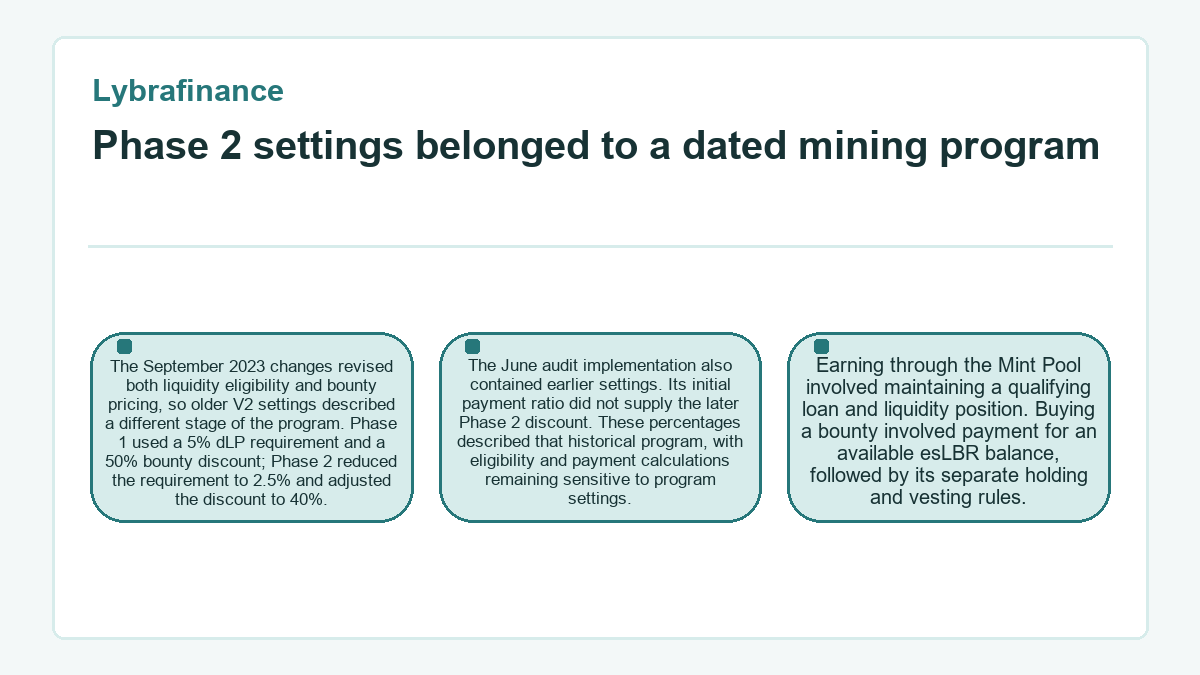
These percentages described that historical program, with eligibility and payment calculations remaining sensitive to program settings. Earning through the Mint Pool involved maintaining a qualifying loan and liquidity position. Buying a bounty involved payment for an available esLBR balance, followed by its separate holding and vesting rules.
Things people ask about Lybrafinance
Did Phase 2 reward eUSD V1, eUSD V2 and peUSD loans equally?
The 2023 Phase 2 program assigned different minting weights: 0.7 for eUSD V1, 1 for eUSD V2 and 1.05 for peUSD. These figures described relative mining weights, not interest rates or fixed esLBR payments to individual wallets. A weighted position still operated within the applicable emissions program and claim conditions.
When did existing mint-pool boosts need reactivation?
The Phase 2 boost update was scheduled for September 15, 2023 at 1:00 PM UTC. Existing boosted users needed to click the boost button again to restart their boost period and retain boosted yield under that update. This instruction concerned that historical change; it was separate from the dLP ratio governing mint-pool reward eligibility.
Was the migration reward multiplier the same benefit as the token-lock boost?
The Phase 2 migration reward multiplier and the token-lock boost had different scopes. The September 2023 program continued migration rewards at 1.5x V2 Base Emissions until further notice, covering minting and the listed LP routes. The lock boost applied only to Mint Pool emissions. Their matching headline multiplier did not describe identical eligibility rules.
Could a bounty buyer select a smaller esLBR quantity in the June 2023 implementation?
The June 2023 mint-incentive implementation bought the target's entire recorded reward balance in a buyout call. Its purchase function accepted a target account and a payment-mode flag, with no requested esLBR quantity. The function calculated the payment from the full reward balance.
Why could an accrued-reward reading stop increasing before a claim?
The June 2023 mint-incentive implementation stopped counting new emissions at its configured reward-finish timestamp. Its accounting used the earlier of the block timestamp and the reward period's end. Ending an emissions interval was separate from claiming an existing reward balance, which still required the applicable dLP eligibility condition.